October is Breast Cancer Awareness Month, but a lump does not wait for October. It can show up on any ordinary Tuesday, while you are packing a tiffin or answering your boss’s email.
Here is the simple version. A self breast examination is a monthly check where you look at and feel your own breasts to learn what is normal for you. It takes about five minutes. If you notice a new lump, a skin change or a nipple change, you get it checked by a doctor.
That is all it is. No machine, no appointment, no cost.
Why breast cancer awareness matters so much in India
Breast cancer is now the most common cancer in Indian women. In 2022, it made up about 26 percent of all cancers in women, with more than 1.9 lakh new cases that year.
Indian women are also diagnosed younger. The average age at diagnosis here is around 49 to 50 years, while in Western countries it is about 62. In one Indian hospital study, about half of the women were already at stage 3 when they were diagnosed.
Late diagnosis is the real problem, because treatment works better when it starts early. The World Health Organization says the same thing: early diagnosis and prompt treatment are the key to reducing the burden of breast cancer.
Why do so many women wait?
Most of us know someone who ignored something small for months. The reasons are very familiar.
“Dard nahi ho raha, toh kuch serious nahi hoga.” Many breast lumps are painless, so women assume they are harmless.
“Pehle bachchon ka, phir apna.” Between work, children and parents, your own check-up always moves to next month.
“Log kya kahenge?” Talking about breasts, even to a woman doctor, still feels awkward in many homes. Some women do not tell their husbands or mothers-in-law at all.
Your health is not a small matter, and it is not a shameful one either. A lump that gets checked early is a very different story from a lump that gets checked late.
When to do a self breast examination
Pick one day every month and keep to it.
- If you still get periods, check about one week after your period starts, when your breasts are least tender and least lumpy.
- If you no longer get periods, pick the same date each month, like the 1st or your birthday date.
- If you are pregnant or breastfeeding, check on a fixed date too. Your breasts will feel different, so you are looking for anything new that stays or grows.
Starting in your 20s is a good habit. Checking daily is not needed and only creates worry.
How to do a self breast examination: 4 simple steps
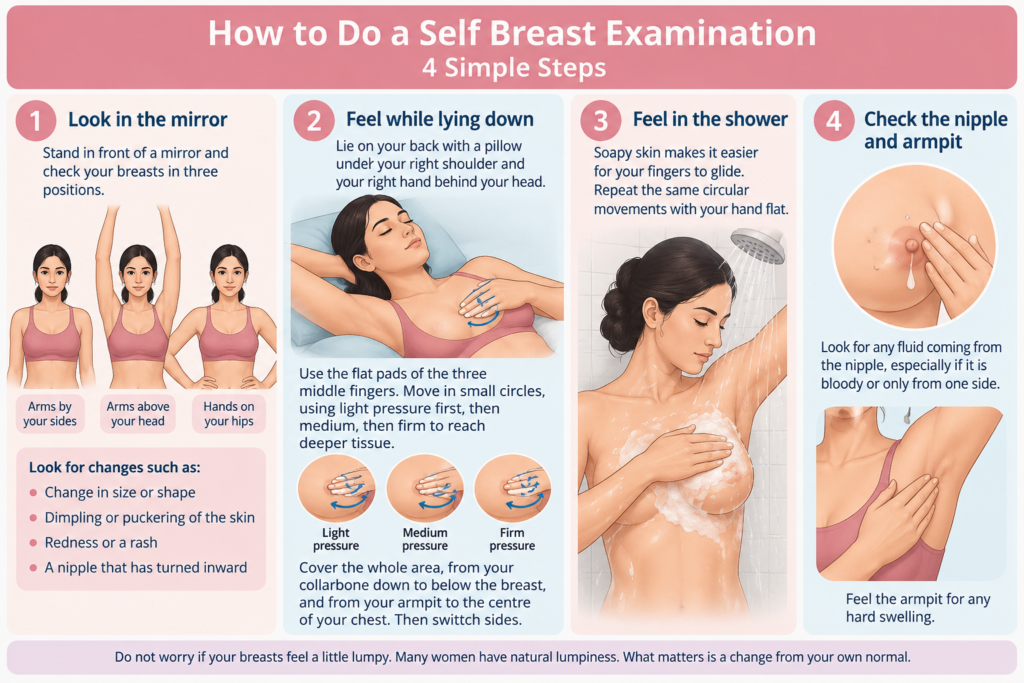
Step 1: Look in the mirror. Stand with your arms by your sides, then raise them above your head, then place your hands on your hips. Look at both breasts for changes in size or shape, dimpling or puckering of the skin, redness, a rash, or a nipple that has turned inward.
Step 2: Feel while lying down. Lie on your back with a pillow under your right shoulder and your right hand behind your head. Use the flat pads of the three middle fingers of your left hand. Move in small circles, using light pressure first, then medium, then firm to reach deeper tissue. Cover the whole area, from your collarbone down to below the breast, and from your armpit to the centre of your chest. Then switch sides.
Step 3: Feel in the shower. Soapy skin makes it easier for fingers to glide. Repeat the same circles with your hand flat.
Step 4: Check the nipple and armpit. Look for any fluid coming from the nipple, especially if it is bloody or only from one side. Feel the armpit for any hard swelling.
Do not worry if your breasts feel a little lumpy. Many women have natural lumpiness. What matters is a change from your own normal.
A breast check at home is a simple way to become familiar with how your breasts normally look and feel.
It is not a substitute for medical screening, and you do not need to follow a rigid technique or schedule.
What is normal and what needs a doctor
| Usually normal | Get it checked soon |
| Tenderness or lumpiness that comes and goes with your periods | A new lump or thickening that stays after your period |
| Both breasts feeling similar to each other | Skin that dimples, puckers or looks like an orange peel |
| Breast changes in pregnancy and while breastfeeding | A nipple that turns inward or changes shape |
| Slight size difference between the two breasts, if it has always been there | Bloody discharge, or discharge from only one nipple |
| A rash or sore on the nipple that does not heal | |
| A hard lump in the armpit | |
| One breast changing in size or shape |
Most breast lumps are not cancer. WHO also notes that any new breast lump should be evaluated by a doctor, even if it does not hurt. Only a proper examination and tests can tell you what a lump is.
What a self examination cannot do
This part matters, so here it is plainly. A self breast examination helps you notice changes early. It cannot find everything. Small lumps or lumps deep inside the breast can be missed, and a mammogram can detect cancers that are too small to feel.
So think of it as one layer of protection, and add the other two:
- Clinical breast examination: a doctor checks your breasts during a routine visit. Many doctors advise this every year from your 30s.
- Mammogram: a breast X-ray. Many doctors in India advise starting between 40 and 50, and earlier if there is a strong family history. The right age and gap depend on your own risk, so ask your gynaecologist.
Please do not feel safe just because nobody in your family had breast cancer. Roughly half or more of women who develop it have no clear risk factor except being a woman and growing older. Family history, obesity, alcohol and hormone therapy after menopause can raise the risk, but the absence of these does not mean you are protected.
Pregnancy, breastfeeding and breast changes
Breasts change a lot during pregnancy and after delivery. They become fuller and more tender, and blocked milk ducts can cause painful lumps that are not cancer. This can make real lumps harder to spot, and it is one reason women delay getting checked.
A lump that stays, grows or does not feel like the rest of your breast needs a proper look, even when you are nursing. Breast health is part of pre and post delivery care, so you can ask for a breast check at your regular visits.
What to do if you find something
First, take a breath. Most changes are not cancer.
Second, do not wait for it to hurt, and do not wait for it to go away on its own. Book an appointment within the next few days. Your doctor will examine you and, if needed, advise an ultrasound or mammogram. If a test shows something that needs a closer look, a small tissue sample (biopsy) gives a clear answer.
Third, go with someone you trust if that helps, but go.
Frequently asked questions
At what age should I start self breast examination?
Most doctors suggest starting in your 20s so you learn your own normal early. Add a yearly doctor’s check from your 30s and ask about mammograms from around 40.
How often should I do it?
Once a month, on the same day each month. If you get periods, choose a day about a week after your period starts.
Does breast pain mean cancer?
Usually not. Pain linked to periods is common, and early breast cancer is often painless. Pain that is new, one-sided and does not settle after your period is worth showing to a doctor.
Is every breast lump cancer?
No. Most lumps turn out to be harmless, such as cysts or fibroadenomas. But only an examination and tests can confirm that, so every new lump should be checked.
Can men get breast cancer?
Yes, though it is rare. About 0.5 to 1 percent of breast cancers occur in men. Any lump in a man’s chest should also be checked.
Your next step
Put a reminder in your phone today for the same date every month. And if you have noticed something and have been putting it off, let this be the push.
Dr Gargi Pal is a Consultant Obstetrician and Gynaecologist with clinics in Borivali West and Kandivali East, Mumbai. To book a breast check or a women’s health consultation, contact the clinic here.
This article is for general awareness and does not replace medical advice. If you notice any change in your breasts, please see a doctor.